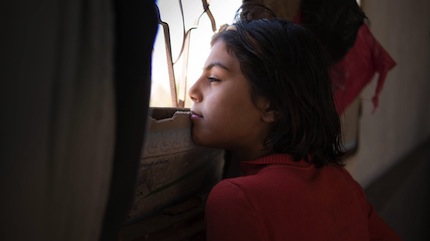
On 16 June, Falak, 12, looks out a window of the house where she now lives with her three surviving siblings, her aunt Siham, two cousins and their mother in Amman, the capital. They share the home with dozens of other child and women Syrian refugees. To escape shelling near their home, Falak’s family had attempted to flee Syria by automobile, but when they reached the main road, a sniper fatally shot her father, the driver. A tank then fired at the car, killing her mother, a brother and her cousinsí father. ìAunt Siham makes us feel like we havenít lost our mother. She is like a mother and a father to us,î explained Falak, who has herself come to play a parental role for her siblings. ìI do for them what our mother did for us,î she said. ìWhen they cry, I try to make them feel better; I tell them, ëDonít cry. Mum didnít die. She is watching us from heaven.í I donít like them to see me sad or crying. I encourage them not to cry, and I donít cry in front of them. I cry when Iím going to sleep.î Her aunts hope to send the children to school at the start of the next term. ìItís safe here, and I feel that I should learn,î Falak said. ìMy siblings and I need to get an education because weíve missed a lot. We must study. I would love to go to school here.î
By late June 2013 in Jordan, over 491,700 Syrian refugees had registered or were awaiting registration with the United Nations High Commission for Refugees. Syrians have also fled to nearby Iraq, Lebanon and Turkey, and as far away as Egypt, bringing the total number to over 1.7 million, more than 869,600 of them children. Inside Syria, some 6.8 million people, including over 3.12 million children, had been affected by the countryís escalating war. UNICEF-supported initiatives in Jordan include the vaccination of 507,448 Syrian, Jordanian and other children aged 6 months to 15 years against measles ñ and the administration of vitamin A supplementation, which boosts immunity, to 207,084 children aged 6 to 59 months ñ during the first two weeks of a campaign launched on 8 June in Irbid and Mafraq Governorates. Since the beginning of the year, a total of 55,235 children in refugee camps and host communities have benefitted from psychosocial activities in child/adolescent-friendly spaces. Initiatives in education include remedial classes for children whose schooling has been interrupted by the conflict. UNICEF-supported programmes in nutrition and water, sanitation and hygiene are also ongoing. To cover emergency responses within Syria and all host countries, UNICEF has appealed for over US$470 million, of which nearly 43 per cent has been funded to date.