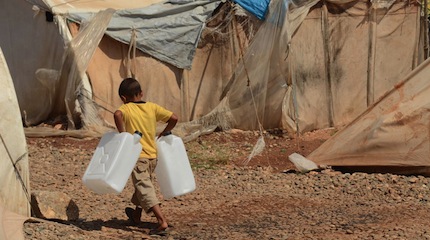
On 19 June, a boy carrying jerrycans walks amid tent shelters in the Atmeh camp for displaced people, in the north-western Idlib Governorate.
By late June 2013 in Syria, some 6.8 million people, including over 3.12 million children, had been affected by the countryís escalating war. Syrians have also fled to nearby Iraq, Jordan, Lebanon and Turkey, and as far away as Egypt, bringing the total number of refugees who had registered or were awaiting registration with the United Nations High Commission for Refugees to over 1.7 million; more than 869,600 are children. Inside Syria, UNICEF-supported programmes are ongoing. Since the beginning of the year, 50 mobile medical teams in 12 governorates and other fixed health centres have administered medical check-ups to 123,206 children. Additionally, by 27 June, a national vaccination campaign set to end at the close of the month had already reached over 1 million children aged 6 months to 15 years with immunizations against measles, mumps and rubella and had protected more than 758,200 children under age 5 against polio. Initiatives in water, sanitation and hygiene include the rehabilitation of water and sewerage systems as well as the continued distribution of hygiene materials to benefit more than 407,250 people, including children and women, in six governorates. Programmes in child protection include psychosocial support services that continue to reach over 48,700 children. UNICEF, in coordination with the Ministry of Education and other partners, is supporting school clubs whose services include remedial classes. To cover emergency responses within Syria and all host countries, UNICEF has appealed for over US$470 million, of which nearly 43 per cent has been funded to date.